
Corsignano: A Case Study of Development as Gift
“All of us, if we are reasonably comfortable, healthy and safe, owe immense debts to the past. There is no way, of course, to repay the past. We can only repay those debts by making gifts to the future.”
Lead Developer: Enea Silvio Piccolomini Lead Designer: Bernardo Rossellino
In the summer of 2025, I returned to visit a small real estate development located in the region of Tuscany in central Italy. Friend and mentor Robert Davis introduced me to this innovative project about 20 years ago, and I looked forward to seeing it again. Among many talents, Robert is a renowned civic artist who, with wife Daryl, led the development of Seaside - the paradigm-shifting 80-acre new town on Florida’s Panhandle.
Built within the historic town of Corsignano, the development was the vision of the late Enea Silvio Piccolomini. And though it comprised less than two of the town’s 13 acres, Piccolomini’s activities created opportunities for others to live and work while providing an inspirational catalyst for further improvements to his hometown and beyond.
Growing up in the tight-knit town of 1,500 people, Piccolomini worked with his father in the farm fields surrounding Corsignano. A bright kid, at the age of 18, he left home for the University of Siena 25 miles away. There he studied the humanities and law, later pursuing further academic work at the University of Florence. Following his formal education, Piccolomini embarked on a career in international relations, serving in England, Scotland, France, Austria, Germany, and Switzerland. He fathered two children during his diplomatic career, but neither survived infancy. Piccolomini was also a successful writer, publishing non-fiction works in history and geography, as well as poems, plays and even an erotic novel entitled Storia di Due Amanti (A Tale of Two Lovers). A career shift at the age of 41 took him to Trieste, a coastal city about 100 miles east of Venice. This was followed by a job promotion that took him back to Siena, then another which landed him in Rome.
Now 53, with the prestige and resources afforded by his latest promotion, Piccolomini began dreaming of a vacation home. Passing through Corsignano on a business trip, he was met with a warm homecoming but left disappointed. Of friends and acquaintances from his own generation, he wrote they were “bowed down with old age and illness, or, if they showed themselves, were so changed as to be hardly recognizable.” The reunion, he wrote, reminded him of “proofs of his own age” and that he “was an old man who would soon drop.” He resolved to try and help his hometown and decided Corsignano would be the site of his second home. A religious man, Piccolomini also sought to rebuild a new church atop the foundation of a historic sanctuary built 200 years earlier.
To realize his dream, the developer hired the Florence-based design-build firm of Bernardo Rossellino. Like Piccolomini, the 40-year-old Rossellino came from humble beginnings, growing up in a farm family in the village of Settignano just north of Florence. In addition to farming, Rossellino’s family owned a quarry. Exposure to the latter business led him into stone masonry. This evolved into sculpture and finally, at the age of 25, into a design-build career. Like his developer client, Rossellino had no formal design education, but possessed a keen sense of observation and, with exposure to hundreds of beautiful villages, towns and cities within a 60-mile radius, drew inspiration from exemplary precedents. Reviewing his work, scholar Charles Mack described Rossellino as:
“…never an imitator and seldom, if ever, an out-an-out plagiarist, he was a selective eclectic. His genius for innovative eclecticism…became a fundamental ingredient of his style. Rossellino constantly appropriated the vocabulary of others, but he so reworked the borrowed phrasings that the result was a highly personal language of his own.”
In addition to improving the architecture and urbanism of his tired hometown, Piccolomini sought to revitalize its social and economic life. Working with the regional government in Siena, Piccolomini secured a tax holiday for Corsignano’s annual May market fair, an abatement of the transfer tax paid on in-town property sales, and a financial incentives package for those willing to relocate. With these measures in place, he proceeded with land acquisition.
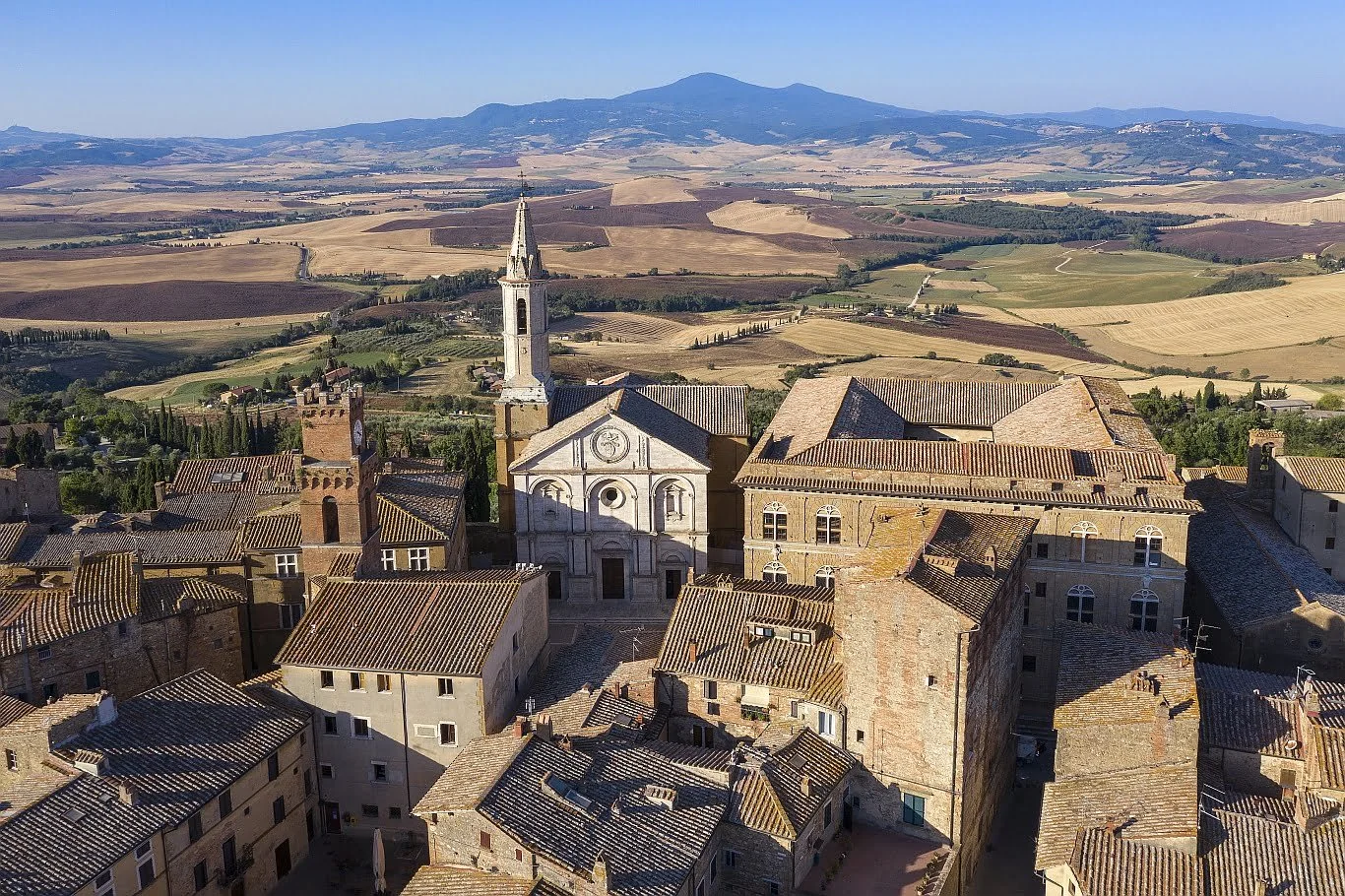
Positioned atop a hill, Corsignano overlooks the Orcia River Valley (Val d’Orcia) - an agricultural region whose beauty is nothing short of spectacular. Land outside its historic limits drops off rapidly on the east and south sides of the village, but is relatively flat on the north and west sides. A lover of nature, Piccolomini wanted his new home to have a view of Mount Amiata, ten miles to the southwest. It would’ve been easier and far cheaper to purchase flat, suburban land on the west side of town. But Piccolomini respected the contrado, an Italian word referring to the countryside surrounding a settled area. A locality’s contrado provides natural resources and agricultural land for the sustenance of its population. Conscious of the importance of these resources to Corsignano, Piccolomini opted to honor the long-established boundary between urban and rural and chose an intown development site near his birthplace.
Though preoccupied with work responsibilities, over the next 18 months Piccolomini, using personal savings, acquired nine parcels of land. With Rossellino on board, and able to tap into his firm’s substantial resources, construction commenced on his home and new church. Following a fall site visit, Piccolomini wrote “highly delighted to see buildings rising in my native place which seemed likely to equal any in Italy.”
The work didn’t come cheap. First phase development costs were almost triple Rossellino’s initial estimate. Still, the developer was overjoyed with the result. And, as fate would have it, alum stone, a rare and valuable mineral, had recently been discovered on firm lands in the Tolfa Mountains north of Rome. Tremendous revenues generated by this discovery provided a windfall that made Rossellino’s higher costs easier to swallow. Hard-nosed, but graceful in forgiving the cost overruns, Piccolomini wrote:
“You did well, Bernardo, in lying to us about the expense involved in the work. If you had told the truth, you could never have induced us to spend so much money and neither this splendid palace, nor this church, the finest in all Italy, would now be standing. Your deceit has built these glorious structures which are praised by all except the few who are consumed with envy. We thank you and think you deserve special honor among all the architects of our time.”
In addition to full pay for work on the first phase, Piccolomini awarded Rossellino a cash bonus, commemorative coat and new design commissions. The contractor “burst into tears of joy.”
Confidence instilled by Piccolomini’s enthusiasm and initial progress prompted others to jump on the bandwagon. His sister Laudomia, for example, purchased property in Corsignano, as did his nephews and other relatives. Associates from work also made purchases to build homes.
Sienese contractor Pietro Paolo was hired to build a dozen affordable 2.5-story row houses. Including adjacent surface parking, the 12-unit rowhouse development was constructed on a 3,400 square foot site (which works out to an impressive 150 units/acre).
In addition to residences, a town hall and hospital were constructed and numerous improvements made to the public realm. For example, Corsignano’s main street was cleaned up, enhanced and re-named “Corso Il Rosselino” to honor his contractor. Ranging in width from 14 to 20’, the street expands and contracts, deflects and bends over its 1,100’ length, adding intrigue and visual delight to one’s walk. At the Corso’s midpoint in front of the new church, Piccolomini developed the town’s crown jewel - a 5,000 square foot (465 square meters) trapezoidal square. The church was cleverly positioned to serve as the gnomon of a large sundial, which casts a shadow on the square to mark holidays and the spring and fall equinoxes.
Piccolomini provided Rossellino the opportunity to put his imagination into practice. His contractor rose to the occasion, carefully designing the heart of the town to form an intimate and civilizing outdoor living room. A place of peace and harmony for citizens and visitors to gather.
Two streets - Via Gozzante and Via del Casello – form a linear park along the southern edge of town enabling public access to breath-taking views over the Val d’Orcia and Mount Amiata. Elsewhere, streets were renamed to speak of love and good tidings. In addition to the Via dell’Amore (Love Street), there’s a romantic Via del Bacio (Kiss Street), and Via della Fortuna (Fortune Street). The relationship between urban and rural and public and private realms results in a whole that is far greater than the sum of its parts.
From concept to home occupation, the first phase spanned three years. And though Piccolomini served as the fountainhead, the bulk of design and development was undertaken by others. Amidst all the building activity, the developer wrote “Many of the townspeople tore down old houses and built new ones, so that nowhere did the aspect of the town remain unchanged.”
Rossellino’s competence, proven track record and hands-on supervision provided Piccolomini with reasonable assurance of a high-quality product. However, the energy and enthusiasm generated by thousands of town building participants guided by Piccolomini’s positive vision, would’ve been impossible to predict. Nevertheless, along with the buildings and public places themselves, a culture of caring and connection formed to create tremendous aesthetic and economic value. And out of this culture grew social value and strong bonds of community – not imposed by the developer, but emerging from the builders and citizenry themselves.
Among other interesting features of the town’s design is what is NOT there: No overhead power lines, fire hydrants, traffic lights, parking lots or superfluous street signs despoil the town’s beautiful public realm. With automobile traffic confined elsewhere, residents, workers and visitors park on the edge of town and walk in.
Italian poet Giovanni Pascoli described Piccolomini’s noble project as "born from a thought of love and a dream of beauty". Recognizing the development to be “of outstanding value to humanity,” UNESCO (the United Nations Educational, Scientific and Cultural Organization) included the Piccolomini-led transformation on its list of World Heritage Sites. Piccolomini’s decision to develop within the town’s historical limits, conserved surrounding suburbs for future generations. UNESCO thus named the Val d’Orcia a World Cultural Landscape.
Film director Jean-Luc Godard once said “It’s not where you take things from, it’s where you take them to.” This statement embodies the animating spirit of Enea Piccolomini who, seeing the possibility of what could be, turned his quiet country village into a renowned place of awe and wonder.
Postscript:
A “Renaissance man” is one capable of mastering many things while keeping himself attuned to the practical effects of his achievements. In that sense, Piccolomini and Rossellino were true Renaissance men. They can also be considered Renaissance men in the chronological sense because, well, they lived during the Renaissance! Piccolomini’s “career shift” at the age of 41 involved being ordained a Catholic priest in 1446. His quick rise through the ranks of church hierarchy culminated with the “promotion” of becoming Pope Pius II in 1458. Corsignano development activities of the Pope and his fellow builders took place between 1459-1464.
Pope Pius II consecrated the new church – the Cathedral of St. John the Baptist – in 1462. That same year, Corsignano was renamed “Pienza” in honor of its hometown hero. Two years later, at the age of 58, Pope Pius II died in Ancona. The punctuation mark on a remarkable life, innovative Pienza is considered “the touchstone of Renaissance urbanism.” It is a gift to the future that keeps on giving.
The Palazzo Picccolomini, the Pope’s home and garden built on a half-acre lot with view of Mount Amiata, is now a house museum open for touring. Pienza’s cathedral and square, its intimate streets, human scale and setting within the glorious Val d’Orcia are worth a visit. Go, and be inspired to improve your own city!
Bibliography:
Adams, Nicholas. “The Acquisition of Pienza, 1459-1464.” Journal of the Society of Architectural Historians, 44 (1985), 99-110.
Mack, Charles R. Pienza: The Creation of a Renaissance City. Ithica, NY: Cornell University Press (1987).
Further reading:
European Research Project - Pienza
Kohr, Leopold. “The City of Man: the Duke of Buen Consejo.” The San Juan Review (August, 1964). Attached below. Whether or not Kohr knew of Pius II, this charming story of a fictional “Duke” leveraging beauty as a tool of economic development in a Puerto Rican shanty town echoes the story of Pienza.
Rybczynski, Witold. Charleston Fancy. Little Houses and Big Dreams in the Holy City. Yale University Press (2019). Rybczynski documents the building endeavors of George Holt, Reid Burgess, Andrew Gould and other contemporary Piccolominis and Rossellinos.